
It has been claimed by some that most Christians today naturally keep most of the commands of Torah, whether wittingly or unwittingly, simply by being good followers of Jesus according to their particular church doctrines. This statement is false and is made by people who do not truly know the Torah, but who think that if they say such things loud and long enough, they will be believed. I think they will not, because most people are not that naïve, and simple math is all that is necessary to disprove and discredit their claims:
· There are arguably 613 Commands in the Torah.
· There are about 77 positive commands (thou shalts) which can be kept today.
· There are about 194 negative commands (thou shalt nots) which can be kept today.
· There are about 26 additional commands which can be kept today, contingent upon one living in the land of Yisrael.
This means that, of the 613, only 271 Torah commands can currently be kept by anyone outside the land of Yisrael – which is roughly 44% of the total. If one lives in the land of Yisrael, about 279 commands could currently be kept, which is roughly 49% of the total possible. This is the best that could presently be accomplished by a perfect Tzadik – a fully righteous man who knows the Torah and scrupulously practices it to the best of his or her ability.
I have personally surveyed numerous Christians and Torah-observant believers in Yeshua over a period of two decades regarding their keeping of the commandments of Torah. In these surveys, I went through every one of the commandments, explaining each in its turn to those who did not understand them, and asking each person these six questions:
1. Should you keep this command?
2. Should you not keep this command?
3. Would you keep this command?
4. Would you not keep this command?
5. Do you keep this command?
6. Do you not keep this command?
The results were amazing and eye-opening, and no one could possibly have guessed them. Relatively pious Christians kept (either incidentally or tried to keep) an average of just 43 positive commands and 42 negative commands of the Torah, a total of 85 or about 31% of the possible 271 commands which can possibly be kept today. All of those surveyed acknowledged that this was an ideal number, and that they did not do so well in daily practice. This means that Christians, on average, keep or try to keep only 14% of the total 613 Torah commands.
Messianics and other supposedly Torah-observant believers in Yeshua fared somewhat better in my surveys, keeping (or trying to keep) roughly twice the number of commandments as their Christian counterparts. They averaged about 150 commands which they thought ideally should be kept, which is about 55% of the 271 possible to keep today, or about 24% of the total 613 commands of Torah. These numbers varied somewhat between them, though not significantly, as there is little agreement between supposedly “Torah-observant” groups about what Torah commands are possible to keep and are binding upon believers today, and because different types or groups of people have certain commands which apply only to them (such as priests, farmers, women, lepers…).
So much for the claim that most believers, especially Christians, keep a majority of the commands of Torah “naturally.” If folks are going to make such claims, they should first do the basic math and be certain of what they are saying. If they do not, they undermine their own credibility and potentially mislead people, whether wittingly or unwittingly.
“Man does not live by bread alone, but by EVERY Word that comes from the mouth of YHWH.”
“If you love me, keep my commandments.”
“And by this we know that we know Him, if we guard His commands. The one who says, ‘I know Him,’ and does not guard His commands, is a liar, and the truth is not in him. But whoever guards His Word, truly the love of Elohim has been perfected in him. By this we know that we are in Him. The one who says he stays in Him ought himself also to walk, even as He walked.”
“Let us hear the conclusion of the whole matter: Fear Elohim and keep His commandments: for this is the whole duty of man. For Elohim shall bring every work into judgment, with every secret thing, whether it be excellent, or whether it be evil.”










i saw something that really piqued my interest, but i could definitely use some help here.
of all things, it's to do with garments, clothing.
(i started off actually just looking for when cloth first came into the picture, the upgrade from animal skins...)
let me show some connects first.
gen 3
- 7And the eyes of both of them were opened, and they knew that they were naked; so they sewed together fig leaves and made coverings for themselves. -
rev 3
- 17You say, ‘I am rich; I have grown wealthy and need nothing.’ But you do not realize that you are wretched, pitiful, poor, blind, and naked. 18I counsel you to buy from Me gold refined by fire so that you may become rich, white garments so that you may be clothed and your shameful nakedness not exposed, and salve to anoint your eyes so that you may see. -
so, basically, one gets the idea that nakedness is shameful. this may seem too obvious to even state. let's thicken the plot.
gen 9
- 22And Ham, the father of Canaan, saw his father’s nakedness and told his two brothers outside.
23Then Shem and Japheth took a garment and placed it across their shoulders, and walking backward, they covered their father’s nakedness. Their faces were turned away so that they did not see their father’s nakedness. -
so, again it is brought up in connection with nakedness.
the sons didn't even want to SEE their father's nakedness...
now, the word garment is simlah, here's strong's exhaustive concordance
- apparel, clothes garment, raiment
Perhaps by permutation for the feminine of cemel (through the idea of a cover assuming the shape of the object beneath); a dress, especially a mantle -- apparel, cloth(-es, -ing), garment, raiment. -
this is where it gets interesting, it's very carefully showing a connect to cemel (semel), again, strong's exhaustive
- figure, idol, image
Or cemel {say'-mel}; from an unused root meaning to resemble; a likeness -- figure, idol, image. -
so, roughly going with a thought wondering if clothing as covering is in some way a form of idolatry, we look at the theme of the original iniquity, of adam, that got him (and eve) to want to clothe themselves.
and up pops job 31
- 33if I have covered my transgressions like Adam
by hiding my guilt in my heart, -
now, to be fair, it actually says bosom, not heart.
but this looks to say one clothes oneself to 'hide' one's guilt.
job says adam covered his transgressions, and genesis says he covered his nakedness. same thing(?).
and now the connect between clothing and idols makes more sense.
we wear clothing to cover our nakedness, but are we actually attempting to hide our guilt over our transgressions in our hearts?
this is not possible of course, as what the Father looks at in us is precisely the heart.
and why the theme constantly comes back that the clothing we wear is nothing more than filthy dirty rags.
- “Who told you that you were naked?” asked the LORD God. -
why (in all innocence) need to cover one's nakedness if one has no guilt? why attempt to 'hide' what's in one's heart from the eyes of the Father?
could be another way to put it.
anyway, this is where i am so far, i hope you can see this is quite intriguing.
does anyone have any knowledge of texts that could expand on this, or does it trigger any thoughts in anyone?
please share them, i'd appreciate it.

"I, Yahweh, thy God, am a jealous God, visiting the iniquity of the fathers upon the children unto the third and fourth generation of them that hate me"
Ex20

Thought for Today: Monday November 17
During the early years of the twentieth century, Bill Borden turned his back on one of America’s great family fortunes to become a missionary to China. He only got as far as Egypt where, still in his twenties, he died of typhoid fever. Before his death he wrote: “No reserves, no retreats, no regrets!” Discipleship is always costly… it will cost us our plans; our wills; our selfish desires. Yeshua’s standard has not changed: “If anyone desire to come after Me, let him deny himself and take up his cross, and follow Me” {Matthew 16: 24}. Follow the Moshiach, and at life’s end you will also be able to say: “No regrets!”
"Ye have purified your souls in obeying the truth through the Spirit unto unfeigned love of the brethren"
1P 1

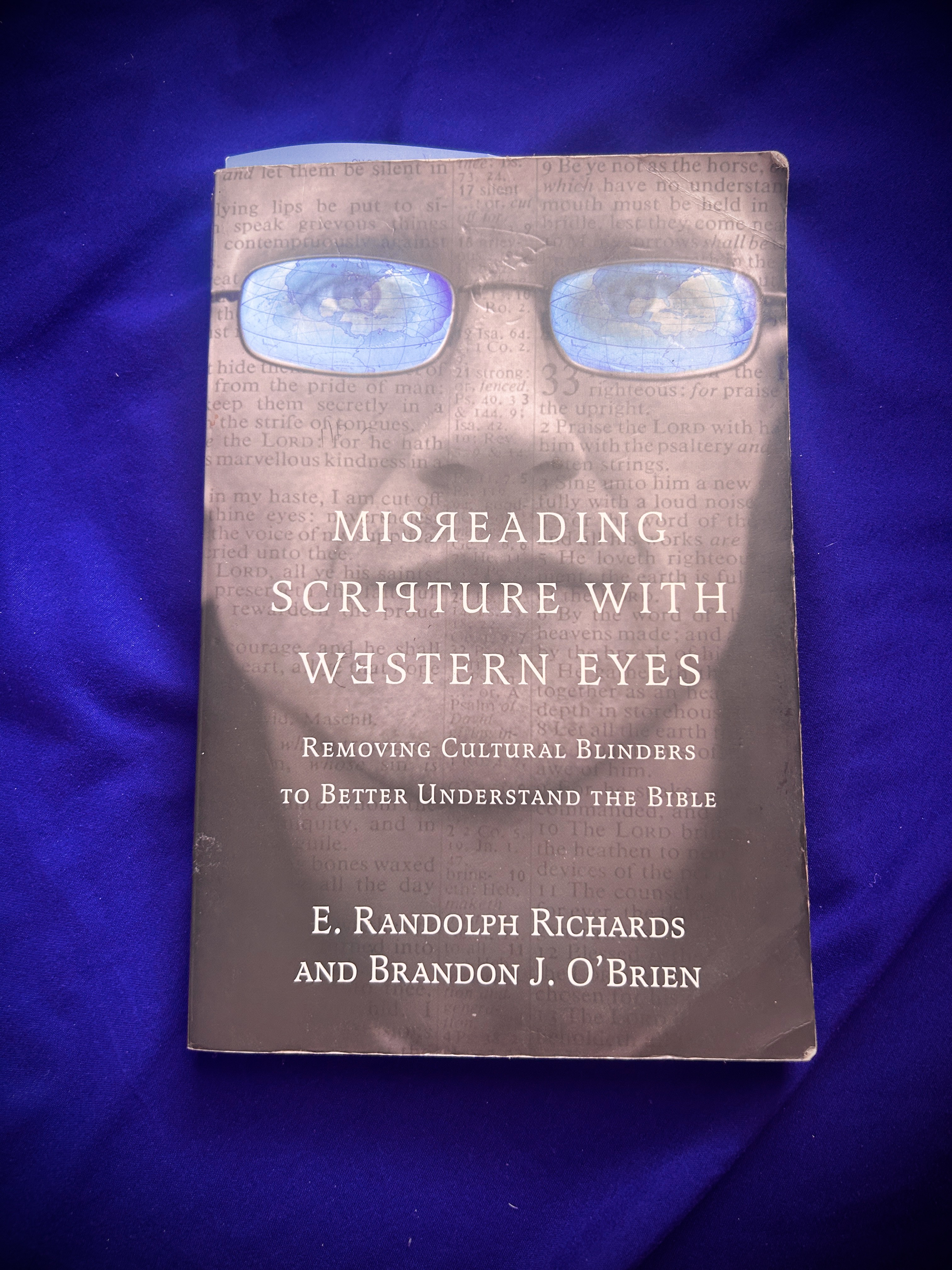
Here’s a book every serious student of scripture would do well to have in their collection….
Especially if you were raised here in the West and have not encountered too many foreign cultures. It is difficult for the average American particularly to understand intellectually that the events of Scriptures weren’t part of the British Empire. Literally everyone knows they happened in the east in Egypt, Babylon, and Israel but intellectually there is a disconnect that happens when reading the Text. We tend to see them from our point of view from our present age and location.
We encourage everyone to Question Everything always, but unless people know a problem exists in our thought process it’s tough to know where to start.
May we suggest beginning here with a look at your world view and whether or not you have let it cloud how you read or rather misread the Scriptures with western eyes.
Second Guess First Assumptions
Question Everything
Get Biblical
templecrier.com/library

#lettertotheromans #wordofyah #everlasting #neverending
#calledtoobedience
#lettertotheromans #wordofyah #everlasting #neverending
#calledtoobedience
Thought for Today: Sunday November 16
Whenever we pray, we need to remember that YHVH’s ways and YHVH’s timing are not always the same as ours. In fact, His time frame rarely matches ours. We also need to remember that YHVH is able to do what we cannot do. Only He can convict non-believers of their sins; only He can convince them of the truth of the Gospel. That is why no-one is hopeless, for He can break through even the hardest heart. “Is not My Word… like a hammer that breaks a rock in pieces?” {Jeremiah 23:29}
 TTN Music
  TTN Promo

Henk Wouters
i quote you
- and because different types or groups of people have certain commands which apply only to them (such as priests, farmers, women, lepers… -
the commands which do NOT apply to each individual asked should have been taken out of the total number of commands, and then the percentages worked out.
this would have brought a truer picture to the fore...
Delete Comment
Are you sure that you want to delete this comment ?